“Public Health is a field that will benefit your community no matter what level,”
says Victor Delgado, a M.S. in Advanced Athletic Training student who graduates in May and plans to pursue a fellowship with the United States
Olympic and Paralympic Committee. “I believe it is an underrated and underappreciated
field and the only way to fix that is to get more people involved and educated in
public health.”
The post-professional division of the athletic training program provides athletic
trainers with diverse clinical sites to practice in while supporting our education.
Victor Delgado
Though invisible to many, public health projects were always underway in Delgado’s
hometown of Laredo, Texas, so he developed an appreciation for the field from a young
age. He began to make the connection between public health and athletic training when
he was studying the latter as an undergrad at the University of Texas at Austin.
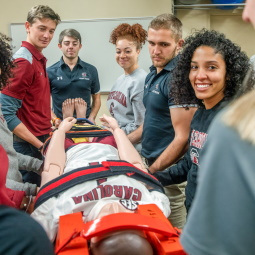
“During my clinical rotations at local high schools, I saw how providing athletic
training services to low-funded schools helped improve student health outcomes,” Delgado
says.
When looking for a master’s program, he was drawn to the Arnold School’s internationally
recognized Department of Exercise Science. Home to a highly respected athletic training program that could provide him with
a top-notch education alongside diverse clinical experiences, the department also
offered compelling financial support.
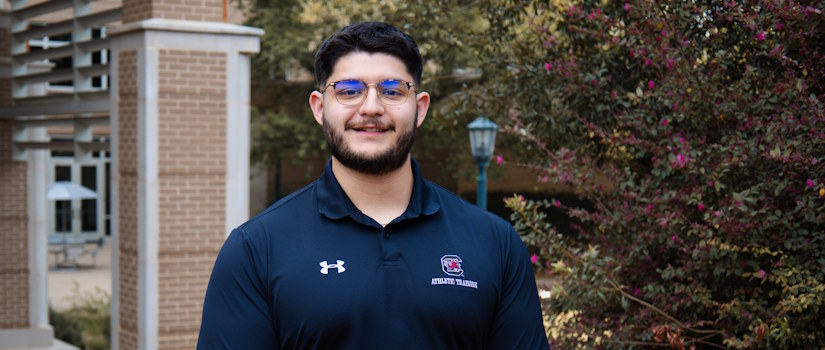
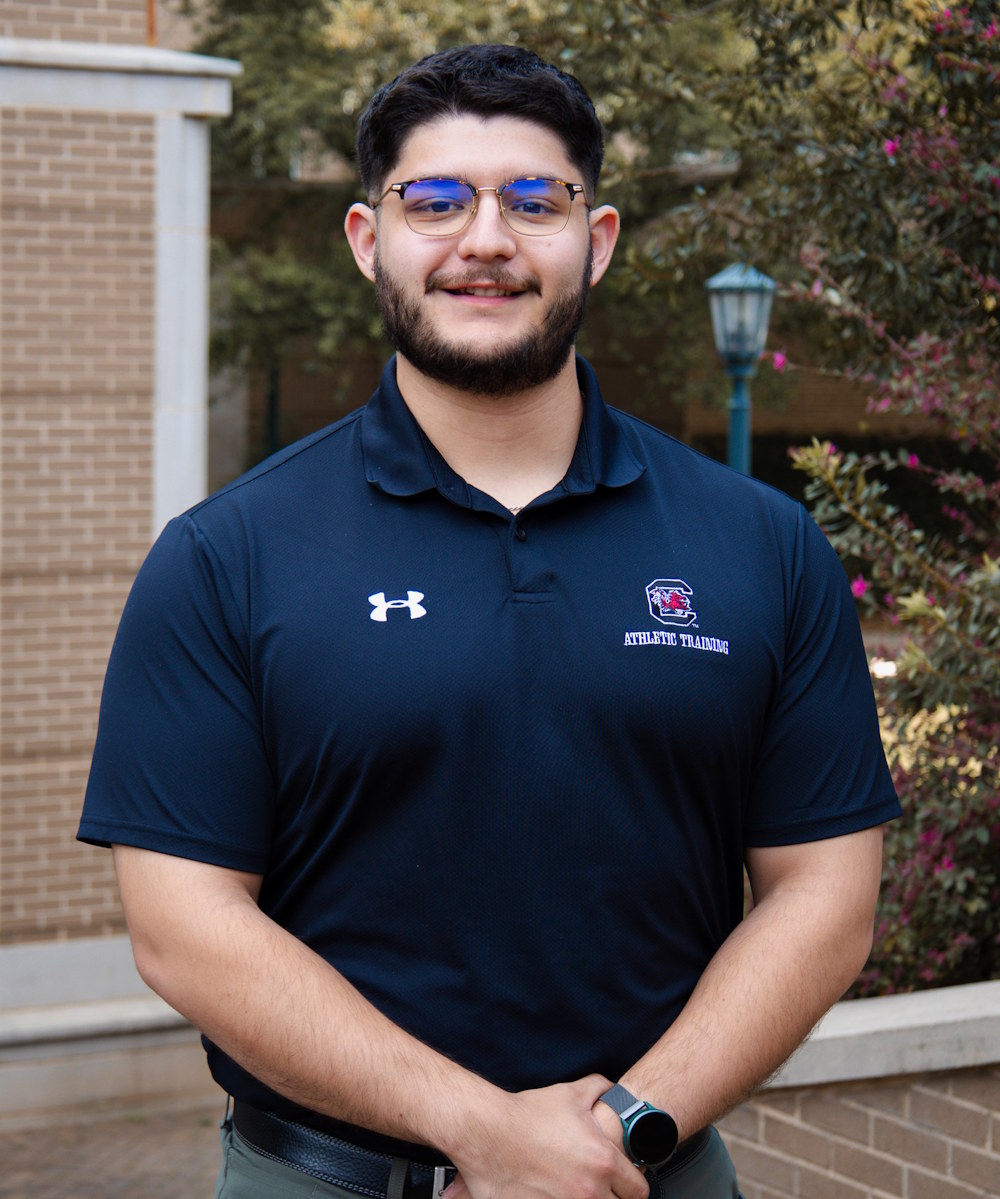
Victor Delgado graduates in May with an M.S. in Advanced Athletic Training.
Over the past two years, Delgado has gained experience as a graduate assistant athletic
trainer for USC Swimming and Diving and Fairfield Central High School. He spent the
summer providing medical services for a Gatorade Sports Camp. Volunteer opportunities
expanded his breadth of experience even further to include youth soccer and cross-country
events, USC football, band and dance, and Prisma Health’s half marathon, 10K and 5K
fundraiser, Walk for Life. From these hands-on experiences and his on-campus coursework,
manual therapy and emergency medicine have emerged as Delgado’s top interests within
the athletic training field.
Though very different from his life in Texas, Columbia’s food and coffee scene plus
its central location for exploring the state have been major bonuses. Being a part
of a tight-knit program with plenty of student comradery and faculty engagement were
also key elements. Despite being short on spare time, he managed to find a local spot,
Powerhouse Weightlifting, to continue the national level Olympic weightlifting he
has had done since high school. Reflecting on his experience, he recommends going
out of state for graduate school as it offers new and different perspectives that
benefit the student.
“The post-professional division of the athletic training program provides athletic
trainers with diverse clinical sites to practice in while supporting our education,”
says Delgado, who found mentors in Toni Torres-McGehee, Susan Yeargin and Zachary Winkelmann. “It is a rigorous program, but that is why it produces quality clinicians.”